
Mesmerized by
the Melvins!
Taken in by
Tomahawk!...
Spill your secrets! Okay, alright, I’ll open the jar — I have been to the Melvins’ magical land, and it goes a little something like this: You unassumingly mosey into the mid-tier concert venue, rest your arms on the barricade, juggle your overpriced ice-cold can of what-have-you to keep your palms from going numb. Hydration will be essential to this experience, so you rest the muscles in your face and bear it. Piped-in jazz plays softly, and the lighting is blue and calm as the black-clad roadies futz about. There are two drum kits tonight, adorned in green glitter with neon-pink skulls and tarantulas on the kicks. To the left and right there are amps — oddly humble in their size, they easily could have been Marshall stacks. Yet as deserving of them as they are, it is not some machine but the Melvins themselves who will soon tower over us. The crowd soon fills the room; in this case, it is a sold-out show. Though, strangely, from your primo position in which you couldn’t have gotten any closer to the band without sitting on the stage itself, you won’t get jostled. And you won’t even think to glance back at the inevitable ‘pit’ anyway. The music will be enough.
Suddenly a line of photographers ushushush into the thin gap between you and that music, station themselves for that three-songs-and-done limit. The jazz fades to silence, replaced suddenly by, in this case, a tape of “The Star-Spangled Banner” (this is Washington, D.C., after all, the city Mike Patton will name later in the night in carnival-barker fashion as “the happiest place on earth!”). The Melvins don’t walk onstage immediately; they hold you captive for about a minute or so, and then there they are, right in front of you. They’re all eyes — literally: the dress code for the night is emerald-green sequins all over bassist Steven McDonald’s white dress suit and stage-right drummer Dale Crover’s black tee-shirt, dotting out the all-too-familiar symbol of divine protection. The other drummer, Coady Willis, is the most minimalist, with his tee bearing just one screen-printed in a white cartoonish outline. The most ceremonial is Buzz Osborne, guitarist, singer and lyricist, whose signature dark robes are gilded with eyes.
But as the band strikes up, the lines immediately blur as to whether or not the Melvins are warding off evil or embodying it. Steven, on loan from the Redd Kross Army, embodies a Dionysian fun, leaping through the air and striking poses with his bass, a soldier of energy and lightness. Yet the tone of his instrument is almost guttural, a deep rumble that vents effortlessly from his pick. And what of Buzz’s stage presence does not correlate with his stage nick-name — totally imposing in his pseudo-regal garb, that candy-floss halo of hair whirling in circles — why, it’s King Buzzo, Lord of the Flies. And from his guitar spits a wheeling, all-consuming wash of heft, the heaviest-of-the-heaviest gnarled grind. From those puny little speakers erupts sound, and it is primal, bearing the weight of centuries.
Yet this weight rests upon the bones of a trickster, reanimated by Dale and Coady as they clatter away, as perfect in their sync as their mortality will grant them. Their percussion takes the songs in odd directions, keeps you guessing as you try and fail to bob your head along, machine-gun fire skipping out with all the energy of a machine. The load of it all flows, macerates you, gives way to a sacred ritual: the drum-off. The two percussionists spar, clattering rat-tat-tat flourishes of woodblock and cowbell puncturing a back-and-forth of exchanged glances and blazing thunder. The excitement builds — and then in perfect sync four arms fly aloft crossing drumsticks and the sound drops. The sudden silence is immediately filled with wild, deafening cheers. You have been initiated.
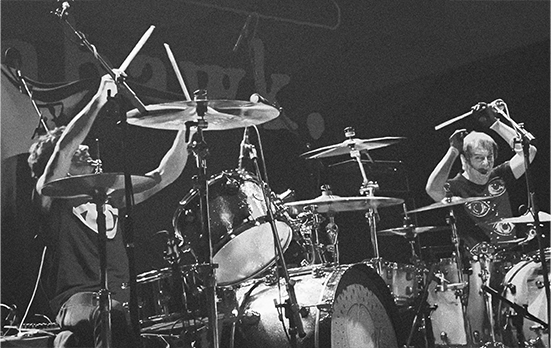
Coady and Dale
We were all initiated, that night in D.C., whether or not it was our first or seventy-fourth time (as it was for one of my friends), whether or not we were or were not prepared. I was prepared, and tortuously so. It had been four long years since I had last seen the Melvins, possibly the hardest working band in America; they tour like maniacs, taking their traveling salvation show up and down and across the country and others as if they require migration to breathe — this recent leg was entitled the “Huge Waste of Your Time and Money Tour” — and yet every time I was back home from college, they were back in Ohio and vice versa.
I was turning eighteen back then, before the waiting game began, and I wanted to spend that special weekend doing something interesting, and the Melvins were playing the resurrected steel town of Bethlehem. Being a bit too invested in punk-rock for my own good, I knew them mostly for their two records with Jello Biafra, and I figured it would be a fun fling. Somewhere along the line I had purchased an old CD of Houdini, which I had listened to maybe once or twice passively, at a now-defunct record store in Lancaster, Pennsylvania, which was named for a Minor Threat song that was once covered by the New Bomb Turks. My folks had seen them a few times back in the day when they supported Patton projects, and The Bootlicker — the second installment in a trilogy they released in the late-nineties on Patton’s Ipecac label — occasionally received play in our car on roadtrips. That record had a soft, strange, uncanny sound, pop music from an alien planet, Buzz Osborne’s voice brought down to an unsuspecting coo. It was coy and delicate music, calming yet riding some creeping edge the way the pins of a haunted music box pluck the teeth of a steel comb.
So my impression of the Melvins was always that of a group who refused expectations and withstood no limits. But nothing could compare me to actually seeing them. Firstly, the venue was astounding: only the hulking abandoned ‘stacks’ of Bethlehem Steel, illuminated by colored lights through the Musikfest’s massive windows, could rival the Melvins’ stature. Secondly, chance granted me a front-row spot directly in front of King Buzzo himself, with maybe five feet separating his guitar from my face. I was terrified and enthralled, and it took three songs — “Oven”, “Lovely Butterflies”, and “It’s Shoved” — for me to be convinced that I was witnessing one of the greatest groups to ever step foot on a stage.

The Melvins and me (photo by Lizette the Mighty)
I did what any fan-girl would: I bought the records, I fell in love with their take-no-prisoners approach to creativity and their embrace of humor and their perverse fascination with Kiss and their fabulous choices in cover songs and Mackie Osborne’s incredible artwork, which has adorned their albums since the nineties. I immersed myself as much as I could in that land, knowing full well that the beautiful gatefolds and scratched-up CD cases couldn’t hold a candle to what I had experienced firsthand. I listened so much I had to give myself a break; I even forgot about the Melvins for a bit, too busy exploring and falling in love with other sounds that were new to me, finding other ‘favorite bands’. And now I was to be seeing the Melvins again, opening for Tomahawk, one of Mike Patton’s most beloved projects, in what would be my first proper witness to one of rock’s most revered impresarios, whose work has hovered over me my entire life.
Such a special occasion called for an elaborate curly up-do arguably more suited for a performance by Franz Liszt, an excessively impractical scarf, stacks of arm jewelry, a favorite skirt and pair of heels, and the tee-shirt my father bought for my mother when he saw Peeping Tom, one of Patton’s best bands, two decades ago. (My mother stayed at home with myself; I was two.) And what better outfit to tell Steven Shane McDonald himself to break a leg — to which he responded “why, you don’t want me to really break my leg, do you?” — as he popped out of the alley behind the 9:30 Club to toss something in the trash. Not that I expected to have a close encounter with the man whose entry into the group triggered the release his own Kiss-style solo album twenty-five years after the Joe Preston-era Melvins decided to have a little bit too much fun. (Given that McDonald is actually their longest serving bassist out of nine, he fully deserved it.) The line for the venue was stretched all the way down the street, placing me right by the alley; it was also stationed beside an even longer line for the Atlantis next door, which was populated by chic teenagers wearing immaculate millennium-bug-age clothing and sharing wired earbuds with each other. At first we — that being me and my parents — actually joined this line, talking amongst ourselves about how impressed we were at such a young crowd! But a kindly 9:30 bouncer informed us that, no, it was actually for some ‘streamer rapper’.
Patton would actually comment on this performance in a lull between songs, having entered the venue through the Atlantis; he claimed the sight of so many cellphones in the air made him feel like a “senior citizen”. Trevor Dunn, his collaborator since high school who formed Mr. Bungle with him, would joke that everyone at the Atlantis was the offspring of his group’s attendees, triggering Mike to call everyone “breeders”, but the crowd Tomahawk drew was truly multigenerational. The disappointing stereotype that the only women present at ‘challenging’ concerts are girlfriends dragged along against their will proved only half-true, as many of the people in attendance that summer night were couples who would have never met if it hadn’t been for the music. To my right at the barricade was a girl around my age who was also there with her folks, and she would be rewarded for her first ever Melvins concert with one of Coady’s drumsticks and a setlist. The one person to sail over the barricade — during “God Hates a Coward”, song two of Tomahawk’s too-long encore — easily could’ve belonged to the Atlantis crowd. And between bands, my father had a conversation with a six-year-old child outside the venue. With big old earphones to protect his vulnerable ears, he declared his favorite Melvins song to be “Honey Bucket”; said his dad, “when I was six, my folks were sitting me in front of the Lawrence Welk Show!”

Mike Patton and Trevor Dunn
I myself have hazy memories of re-runs of the big-band variety-show, though not so much ‘breakfast with Mr. Bungle’, which was when my father would play baby-me a bootlegged videocassette of a professionally shot concert from the California tour as he spoon-fed me formula in my high chair. The same goes for the bib he bought for me at the Fantômas merch booth once upon a time (see photo at top of page). But I can distinctly recall him pointing out to me Roddy Bottum from behind the keys in an old Faith No More music video — either he or Rob Halford would be the first person I ever knew was “gay — and there’s nothing wrong with that.” And I definitely remember gingerly flipping through the mini-calendar included with Fantômas’s Suspended Animation, almost scared of Yoshitomo Nara’s cuddly drawings as if they were some sort of forbidden knowledge, something I was not supposed to see, despite being raised in an environment where that which is abnormal is not only tolerated but accepted.
Despite being immersed in his work since birth, I had only seen the ever-versatile and ever-unpredictable General Patton once before, about a month before the Tomahawk-Melvins Big Gig. My hopes of seeing Faith No More and Mr. Bungle back-to-back a few years prior had been dashed when Patton cancelled both tours with little warning, so I had to wait until his recent stint with the Avett Brothers, a well-loved folk-rock ensemble, brought him to a free concert an hour north of my hometown. Billed as Pennsylvania’s pregaming for the semiquincentennial — “We put the ‘PA’ in ‘party’,” declared numerous corny videos that cycled on the big screens as a deejay tried to make everyone sing along to “Sweet Caroline” — the stadium was half-empty, and the lemonade was fourteen-dollars a pop. The opener, however, was Joan Jett, gorgeous as ever and covering “Everyday People” with much aplomb. And my mother’s finageling us all ‘pit’ tickets from a man wearing red-white-and-blue overalls would pay off, as we got to see AVTT/PTTN in all their charm and my father’s favorite singer in his element. The two Mr. Bungle tunes they’d been interpreting had been cut for time, but “Digging the Grave” and “Easy” were pitch-perfect, with Patton sounding as if it were the halcyon nineties all over again, his voice astonishingly indistinguishable from a polished studio recording. The Brothers themselves also won me over with their talent and humility, their exceptional ability to spin a story, their lust for a good sing-a-long. They sang of “cigareeettes, whisk-ee n’ waaahld, waaahld wimm’n”, and Patton’s chiming-in from behind his ubiquitous keyboard battlestation was beautiful and honest; on a great Dean Martin cover, they sang of the whippoorwill, one of fauna’s most severely underappreciated birds. And they ended the night on “Talk on Indolence”, a true stomper of a number that truly made me so sad the night was ending. Too did the sight of the lanky baseball-capped lad beside me, who closely resembled my friend who deals in vintage political memorabilia back in Ohio and was obviously having a religious experience. Slightly awkward in his mouthing- and clapping-along, I could tell that even if he would’ve paid much more than the twenty-five-dollar parking fee that night, he would’ve been standing right where he was. I wasn’t the only one aware and captive to the power of music.
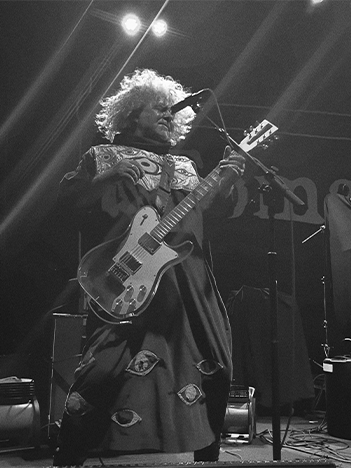
King Buzzo
Patton, a man who knows no genre to the extent of embodying a genre unto himself, knows that power as well. The year following that wave of cancelled shows, he would admit that it was the fault of an intense bout of agoraphobia. Now he was back in action, sobered up and describing his time with the Avetts as some of the most fun he’d ever had on tour; he was prepared once again to face his devoted followers. And that last Tomahawk record — 2021’s Tonic Immobility — was not only great but a product of the coronavirus pandemic, making it dreadfully overdue for a tour. My four-year wait for another Melvins face-melting, meet five for “Fatback”.
The Melvins — who were preceded by a brief bit of atmospheric theremin noodling by a man wearing a mask and no shoes — of course delivered within their measly hour-long time limit. I spent most of their performance a bit speechless, watching in reverence as their sick songs rolled out from under their flying thumbs. But I was spirited enough to scream along to a few — the aforementioned “It’s Shoved”, “The Bit”, and the much more recent number I was really hoping they would play again, “Never Say You’re Sorry”. The beautiful thing about Melvins songs is that half of the time, their lyrics are a sort of esoteric scat, more reliant on how interesting words sound when placed together than being concrete. Scholars have not yet mined these probably-meaningless texts for their potential for meaning, and it’s a pity, because what power they can have, whether you’re immersing yourself in a psycho-sexual horror film — the latter song — or letting “The Bit”’s hypnotizing swirl sweep away your inner chains, or however you may interpret those songs which make abstract elocution of often-unspeakable emotions and situations. The effect can be massive.
The stage, however, felt tiny, as Tomahawk’s gear was already set up behind them. The decreased floor room resulted in both drum kits being front and center, leading the charge and promoting egalitarianism among the four powerhouse talents. This peculiar layout combined with having Coady in tow — only Dale was drumming when I’d seen them last — was in many ways transformative, with the interplay between the two proving a sight to behold — the way they truly played together, their competition fueled by true camaraderie. Between the (not-so-)young buck and the elder(ish) statesman— they’re actually only seven years apart in age — manifested a bond of respect, joy, and love that arguably stole the night. With the beautiful fury of their rapport the set blazed by disgustingly fast, and they wouldn’t do “Revolve”, which I was really hoping they would, which I guess is just another reason to see the Melvins. Again.


Steven and Trevor spar
Its conclusion would be handsome, though, with Trevor Dunn himself joining the group for their final number, “Night Goat”. The song is all-out Melvins, and seeing it in this state further proved that the only thing better than the Melvins with two drummers is the Melvins with two drummers and two bassists. Wearing a red checkered button-up and a striking grey cowboy hat, Trevor was as all-American as an underground-rock star can get, and he and Steven would themselves face off in a much more comical bass-off. Being there in the capital of the free world, seeing these two men mimic each other, the Eureka-born wrangler beside the Spirit of ’76 star — that’s Redd Kross’s fabulous film where they have to help a time-traveling David Cassidy navigate the bicentennial — it was C-SPAN worthy, an outstanding display by one of the country’s most unique and industrious sonic exports.
Unfortunately, my guitar-centric position meant that the ‘cowboy bass player’ (as Patton would call him) was mostly hidden behind Mike and his table of toys after Tomahawk took the stage. Sometimes I’d catch his lurking shadow as it rested against the bass amp, his ten-gallon peeking out from behind Mike’s shoulder. But unless he was saddled up to the microphone contributing backing vocals, he evaded my line of sight. I suppose the old adage is true: a woman’s work really is Trevor Dunn. Not that I would ever complain about being right in front of guitarist Duane Denison, best known for his work with one of the only groups to rival the Melvins in their abrasiveness, the Jesus Lizard. If you’d caught him in his sharp short-sleeved black button-up or drummer John Stanier out and about, grabbing a burger at a rest stop or taking their turn at filling up the van’s tank, you’d assume they were just your usual older gents whose road trips centered around, say, fly-fishing. But John’s Helmet-honed chops made him a ferocious beast behind the kit, his cymbal stands wobbling back and forth in petrified worry as he slaughtered his toms. And then there was Duane, whose control of his instrument had a back-of-his-hand coolness that only amplified his nimble flexibility. On songs like “Shhh!” he would seamlessly launch from delicate pin-prick plucking to hammer-down heaviness; on others, he wielded a lurid, drawling twang evocative of a quirly-smoke haze.
The result was always cinematic, regardless of a song’s tone or heaviness. Images of a modern-day cowboy noir — seedy bars for saloons and the setting sun peeking through the cracks between skyscrapers — flashed in my mind as Tomahawk played on. The world they formed for us clearly ran on unearthed blank stock of celluloid, cellphones and beat-up old Hondas illuminated in grainy Techniscope, like the B-roll in an Anna Biller film or a brief flash of normalcy in one by David Lynch. When I glanced behind me to see if a mosh pit had formed, I caught a split-second glimpse of another redheaded woman doing the same, half of her face soaked in snow-white and the other half the same lapis-lazuli blue that defined the post-show lull; it was a snapshot moment that will never occur again, and it easily could’ve been blown-up on a one-sheet, framed by shocking-font slogans. And at one point during the night, as Patton hissed the words “bad cholesterol, business casual”, a single fleck of white confetti floated down from the sky and landed ever-so politely at the edge of the stage. Talk about choreography.

Tomahawk
Obviously Patton’s power as bandleader was front and center, both literally and psychologically. While the Melvins may have been my main attraction, here we all were, women and men, here to enjoy some good old fashioned Mike Patton music. Whether we fought for our spot on the floor or were hanging up in the balcony, our shared appreciation for his creative gifts had united us under this humble roof, gathered us in a hall so hallowed it has an official cupcake. When trying to pinpoint the status Patton has accrued in the pantheon of rock and roll, it’s easy to go scatterbrained at all he has accomplished, at every boundary he has flagrantly tossed into the wind. He’s filled stadiums with Faith No More, performed with renowned orchestras, attracted acclaim, admiration, and fascination from across the full spectrum of musical sensibility. To name just a few, he’s interpreted compositions by the Stormtroopers of Death (“Speak English or Die” became “Speak Spanish or Die”), Van Halen, the Commodores, 10cc, Billy Squier, Eric Carmen, Olivia Newton-John, and Oingo Boingo; he used the fame the music video for “Epic” accrued him and the other members of Faith No More to release perverted clown music on the decidedly stately Warner Brothers label; his lengthy Wikipedia page includes a photo of him posing with the President and First Lady of Chile; he once swallowed a shoelace that was tossed on stage, dramatically and loudly hocked it up, and hurled the pale, wet garden snake back into the audience. Nowadays, he is much calmer, more contemplative. But he was never not a professional. But can a man who rejects star-dom claim the label of ‘rock star’, even when he has routinely proven himself to be more than just a mere musician?
Watching Tomahawk perform affirmed to me more than ever that Patton is a sort of sonic auteur. The Director’s Cut, the Morricone tributes, the record of songs by Jean-Claude Vannier — it all clicked into place, and all I needed for that to occur was the emotions I felt observing him in his element. One could rattle off technical terms to try and capture his creativity in qualitative terms, pin down its parts like the wings of a butterfly, but one must only see him perform to recognize how his oft-imitated creativity cannot be reduced to such things, and that doing so would provide no further avenues to truly understanding his irreplaceable approach to music and art.
And then there are the Melvins. What other group is so infused with such personality and defiance? They are capable of slowness, of speed, of laughter, of dread; their Lord of the Flies extended-play, brand-new when I first saw the band, proved they can take on “Misty Mountain Hop”, and their scope could be easily compared to Led Zeppelin, with each record as titanic as it is diverse and harboring a distinct personality. They are one of rock’s few true success stories, not only still in existence but releasing music that dares to define their career, and they do so regularly. They don’t embarrass themselves by pontificating or projecting self-importance; instead, they tell it like it is. And they certainly couldn’t care any less about the labels the entomologists seek to assign them. They are, at heart, a damn good rock and roll band. Dare I say that they are the most American-band American band since Grand Funk Railroad.
And yet they, too, appear to discard the ‘rock star’ trapping, though Steven is unabashed in his showmanship, and Buzz has become one of rock’s most titanic figures through his own, entirely individual persona. As it may with Patton’s oeuvre, the breadth of the Melvins’ atmosphere easily confuses a potential lowest-common-denominator audience, the sort that repelled critics from Plant and Page; how does one get into the groove of a group who have consistently issued classics, a group so good that even their laziest jokes land like sucker-punches? How does one become properly influenced by them in an age where influence must be proper, simplistic, one-note? Where does one even begin with them?
Maybe the best way to start is to simply saunter into that spiritual Budokan of a room, preconditioned or not, take the time to bask in that blue glow, and wait and see what hits you. You never truly know until you show up. Now all we need is for Fantômas to get back together, and world peace will be achieved.